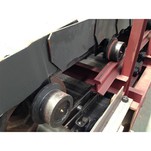

Bucket elevator chains, with their blades cast from stainless steel using specialized molds, boast a remarkably smooth, burr-free surface and high strength and rigidity. This ensures appropriate rotational speed, effectively preventing contamination and clogging during the conveying of screenings, and preventing blade deformation even with large conveying volumes.
The bucket elevator chain primarily consists of a shaftless screw, U-shaped spiral grooves, cover plates, liners, inlet and outlet ports, discharge port, and drive unit. Lump or granular materials are input through the inlet, propelled by the screw, and then discharged through the outlet. The screw drive, located at one end of the chain, utilizes a direct connection between the electromechanical reducer and the screw drive shaft, eliminating the need for couplings. This facilitates assembly and maintenance, as the screw drive shaft withstands both bending moment and axial pressure loads simultaneously. Its driving electromechanical parameters are: 380 volts, three-phase AC, 50 Hz, protection rating of IP55, and insulation class of F. The lining inside the conveying trough is generally designed in a semi-circular shape to match the radius of the spiral, thereby improving conveying efficiency.